



Use AI to summarise this article
Introduction
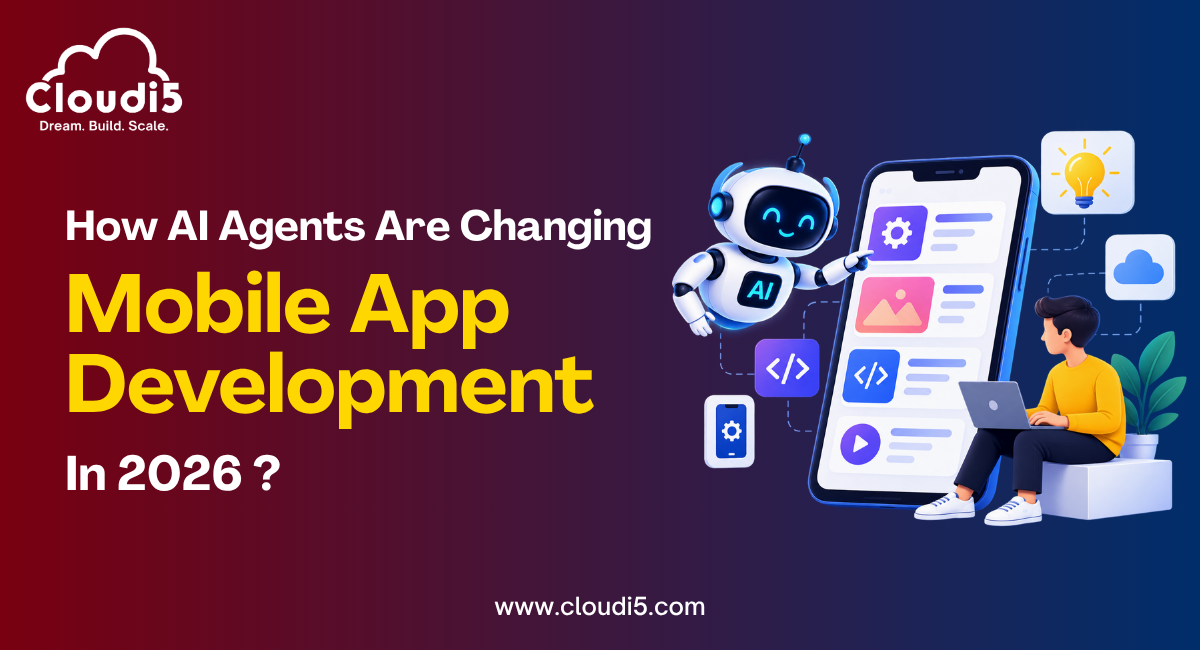
Mobile apps have become much more than screens for viewing information or completing one action at a time. Users now expect apps to understand what they are trying to do, remember relevant context, and make the process easier. This is where AI agents are becoming increasingly relevant to mobile app development.
A traditional AI feature might answer a question, recommend a product, or generate a piece of content. An AI agent can go a step further by working toward a specific goal, deciding which permitted action to take next, and interacting with connected tools or services. In a mobile app, this can turn a long series of taps into a simpler conversation or guided workflow.
For businesses, the change is important because AI is moving from being a standalone feature to becoming part of the way an application works. The opportunity is not simply to add a chatbot to an existing app, but to identify tasks where intelligent assistance can genuinely improve the user experience.
Cloudi5 Technologies works on mobile applications that combine practical user experiences with scalable application architecture. For businesses exploring AI-powered mobile apps, the right approach starts with understanding the business process, the users, the available data, and the actions an AI system should and should not be allowed to perform.
Table of Contents
-
What Are AI Agents in Mobile App Development?
-
AI Agents vs Traditional AI: What Is the Difference?
-
How AI Agents Are Changing Mobile App Development?
-
1. From Rule-Based Workflows to Goal-Oriented Experiences
-
2. Faster Development, Testing and Debugging
-
3. Multi-Step Task Automation
-
4. More Contextual Personalization
-
5. Smarter Customer Support
-
6. Better In-App Assistance
-
Real-World Use Cases of AI Agents in Mobile Apps
-
Key Features of AI Agent-Powered Mobile Apps
-
Benefits of AI Agents in Mobile App Development
-
Challenges of AI Agents in Mobile App Development
-
How to Choose the Right Mobile App Development Company for an AI-Powered App?
-
Conclusion
-
FAQs
What Are AI Agents in Mobile App Development?
An AI agent is a software system designed to work toward a defined goal by understanding instructions, processing information, making decisions within its permitted scope, and taking actions through connected tools or services.
This is different from a basic AI feature that simply produces an answer. For example, a chatbot may tell a customer which products are available. An agent-based shopping assistant could understand what the customer wants, search the product catalogue, narrow the options, check relevant information, and guide the customer through the next steps.
The important point is that an AI agent does not mean an app should be given unlimited control. Good agentic mobile applications use clear permissions, defined workflows, appropriate API access, security controls, and human confirmation when an action has important consequences.
AI Agents vs Traditional AI: What Is the Difference?
|
Area |
Traditional AI Feature |
AI Agent |
|
Interaction |
Usually responds to a specific request. |
Works toward a defined user goal. |
|
Workflow |
Often performs one focused task. |
Can coordinate several permitted steps. |
|
Decision-making |
Typically follows a predefined interaction. |
Can select the next appropriate action within its rules. |
|
Tools |
May operate mainly within one feature. |
Can interact with approved APIs, databases or application functions. |
|
User experience |
Often question-and-answer based. |
Can be task-oriented and action-oriented. |
How AI Agents Are Changing Mobile App Development?
AI agents are influencing both sides of mobile app development: the way applications are built and the way users interact with them. The following changes are especially relevant for businesses planning AI-powered applications.
1. From Rule-Based Workflows to Goal-Oriented Experiences
Many mobile applications depend on fixed workflows. A user selects an option, moves to another screen, enters information, and completes the next step. These workflows work well for predictable tasks, but they can become cumbersome when the user does not know exactly where to start.
AI agents can provide another way to interact with the application. Instead of navigating through several screens, a user can describe the goal in natural language. The application can then identify the intent and guide the user through the permitted actions.
For example, a food delivery app could allow a user to say, 'I want the same type of dinner I ordered last Friday.' The system could identify the previous order, check whether the restaurant and items are available, and present the result for confirmation.
Businesses should still keep important actions transparent. An agent should not silently place an order, make a payment, or change sensitive account information without the appropriate permission or confirmation. Read our blog on AI In Mobile App Development to learn more about the top AI features.
2. Faster Development, Testing and Debugging
AI is also changing the development process itself. Developers can use AI-assisted tools to generate code suggestions, create test cases, review code, identify possible bugs, explain errors, and prepare technical documentation.
This is slightly different from an AI agent operating inside the finished mobile application. Developer-facing AI tools support the engineering team, while customer-facing AI agents support users. Keeping these two use cases separate makes it easier to plan the right architecture and tools.
For businesses, the practical benefit is that development teams can spend less time on repetitive work and more time on application architecture, user experience, security, testing, and business-specific functionality.
3. Multi-Step Task Automation
One of the most useful applications of an AI agent is handling a task that normally requires several separate actions.
Consider a travel application. A user might ask for a weekend trip within a particular budget. Depending on the application's integrations and permissions, an AI assistant could help identify suitable destinations, compare available options, organise the itinerary, and guide the user toward booking.
The value comes from coordinating the workflow rather than simply generating a response. Each action should still be limited by the permissions, business rules, APIs, and approval steps defined by the application.
4. More Contextual Personalization
Personalization has been part of mobile applications for years, but AI can make the interaction more contextual. An application can use relevant preferences, previous interactions, current activity, and other permitted information to provide more useful assistance.
For example, an e-commerce application could help a returning customer find products based on previous browsing or purchase activity. A learning application could adjust recommendations based on the learner's progress and the subjects they are working on.
Personalization should always be balanced with privacy. Businesses need to understand what data is collected, why it is used, what permissions are required, and how users can control their information.
For more on this subject, see our article on How Can Mobile Apps Improve User Experience With Personalization?
5. Smarter Customer Support
Customer support is another area where AI agents can reduce repetitive work. Instead of directing every customer to a separate help page, an AI-powered assistant can understand the question, retrieve relevant information, and guide the customer through an appropriate process.
For example, an online shopping app could help a customer understand an order status, explain a return process, or find information about a product. If the issue requires human judgement or access beyond the agent's permissions, the conversation can be transferred to a support representative.
This combination of AI assistance and human support can be more practical than trying to automate every customer interaction.
6. Better In-App Assistance
AI agents can also act as an intelligent layer across different parts of a mobile application. Instead of making users search through menus to find a feature, the assistant can help them discover what the application can do.
For example, in a finance application, an assistant could explain a transaction, help locate a statement, or guide a user to the relevant account setting. The exact capabilities depend on the application's architecture, data access, security model, and business rules.
Real-World Use Cases of AI Agents in Mobile Apps
- E-commerce: Product discovery, personalized recommendations, order assistance, returns and customer support.
- Food Delivery: Restaurant discovery, repeat orders, order-related assistance and delivery support.
- Travel: Trip planning, itinerary assistance, destination discovery and booking workflows.
- Healthcare: Appointment assistance, reminders, general information and navigation through permitted services.
- Education: Learning assistance, study planning, content discovery and personalized learning support.
- Banking and Finance: Transaction explanations, account navigation and customer-service workflows, subject to strong security controls.
- Customer Service: Issue identification, information retrieval, guided troubleshooting and escalation to human agents.
Key Features of AI Agent-Powered Mobile Apps
- Natural language understanding: Users can communicate with the application using conversational language rather than relying entirely on menus.
- Context awareness: The system can use relevant conversation or application context to make responses more useful.
- Task automation: The agent can coordinate multiple permitted steps instead of requiring the user to complete every step manually.
- Personalized recommendations: The application can use relevant user preferences and behaviour to provide more contextual suggestions.
- Tool and API integration: Agents can connect to approved APIs, databases and application functions when the architecture permits it.
- Human approval: Sensitive or high-impact actions can require confirmation before they are completed.
- Monitoring and controls: Businesses can define permissions, logs, limits and fallback processes to make agent behaviour safer and easier to manage.
AI-assisted development is another related area worth exploring. Read our article on The The Future of Coding to learn more about the growing role of AI in software development.
Benefits of AI Agents in Mobile App Development
- Reduce repetitive steps in selected user workflows.
- Make applications easier to interact with through natural language.
- Help users discover relevant features and information more quickly.
- Support personalized experiences when appropriate data and permissions are available.
- Assist development teams with coding, testing, debugging and documentation.
- Improve customer-support workflows by handling routine requests and escalating complex cases.
- Create opportunities to connect mobile apps with multiple business systems through controlled APIs.
Challenges of AI Agents in Mobile App Development
AI agents can provide useful capabilities, but adding them to a mobile application also introduces technical and operational challenges. Businesses should plan for these challenges before moving an AI feature into production.
- Accuracy and unreliable outputs: AI systems can sometimes produce incorrect information. Important workflows need validation, clear boundaries and suitable fallback mechanisms.
- Security and permissions: An agent connected to application functions or third-party services needs carefully defined permissions and access controls.
- Privacy: Applications may process personal or sensitive information. Data collection, storage, access and retention need to be considered during architecture planning.
- Integration complexity: Connecting an agent to mobile features, backend systems, databases and third-party APIs can require significant engineering work.
- Cost: AI model usage, cloud infrastructure, monitoring, testing and ongoing maintenance can affect the overall cost of the application.
- Performance: AI requests and external service calls can add latency, so applications need suitable architecture and user-experience handling.
- Monitoring: Agent behaviour needs to be monitored after launch so teams can identify errors, unexpected workflows and changing model behaviour.
Security becomes especially important when an AI system can access application data or perform actions on behalf of a user. Our article on Security Trends in Mobile App Development covers additional security considerations for modern mobile applications.
How to Choose the Right Mobile App Development Company for an AI-Powered App?
Choosing a development partner for an AI-powered application involves more than checking whether a company can build a mobile app. The team should understand how mobile technology, backend systems, APIs, AI models and security controls work together.
- Experience with mobile application development and the framework appropriate for the project.
- Experience integrating AI models, APIs and backend services.
- Understanding of data privacy, authentication and access control.
- Ability to design workflows where AI actions are clearly limited and auditable.
- Experience with testing, monitoring and maintaining AI-enabled features after launch.
- Ability to design for scalability as the number of users and AI interactions increases.
- Clear understanding of the business process the application is expected to improve.
Cloudi5 Technologies provides mobile app development services for businesses looking to build applications around their specific requirements. Our team works with technologies including Flutter, Android, iOS and React Native, along with backend and API integrations required for modern applications.
For businesses looking for a mobile app development company in Coimbatore, the focus should be on choosing a team that can understand the complete product rather than adding AI simply because it is a current technology trend.
Conclusion
AI agents are changing the way businesses think about mobile applications. Instead of limiting AI to chatbots or individual recommendation features, developers can use agent-based approaches to help users complete tasks, navigate applications, find information and receive more contextual assistance.
At the same time, successful AI-powered apps require more than an AI model. Businesses need a suitable mobile architecture, reliable backend integrations, clear permissions, privacy controls, testing, monitoring and a well-defined user experience.
The right use of AI agents depends on the problem being solved. When an agent genuinely removes unnecessary steps or improves the way users interact with an application, it can become a valuable part of the product rather than just another feature.
Cloudi5 Technologies helps businesses plan and develop customized mobile applications based on their technology and business requirements. If you are planning an AI-powered mobile application, you can Get in touch with our team to discuss your requirements.
FAQs
AI agents are software systems that can understand a user's goal, process relevant information, make decisions within defined limits, and perform permitted actions through application features or connected services.
They are helping applications move beyond simple question-and-answer interactions toward task-oriented experiences, including multi-step workflows, contextual assistance, personalization and automated support.
A conventional AI feature may generate an answer or perform a focused task. An AI agent is designed to work toward a goal and may coordinate multiple permitted actions to complete that task.
Yes. AI agents can use relevant preferences, previous interactions and application context to provide more personalized assistance, provided the necessary data and permissions are available.
Depending on the project, developers can combine mobile frameworks such as Flutter, Android, iOS or React Native with AI APIs, language models, backend services, databases, cloud platforms and third-party APIs.
The cost depends on the application's features, AI model usage, integrations, backend architecture, security requirements, testing, expected traffic and ongoing maintenance. There is no single cost that applies to every AI mobile app.
It can coordinate multiple permitted activities when the application has the required integrations and permissions. Sensitive actions may require user confirmation or additional safeguards.
Security depends on how the application is designed. Authentication, authorization, data protection, API security, monitoring, permission controls and appropriate human approval are important when agents can access data or perform actions.
Cloudi5 Technologies provides customized mobile application development services and can work with AI integrations and modern mobile technologies based on a business's requirements.