

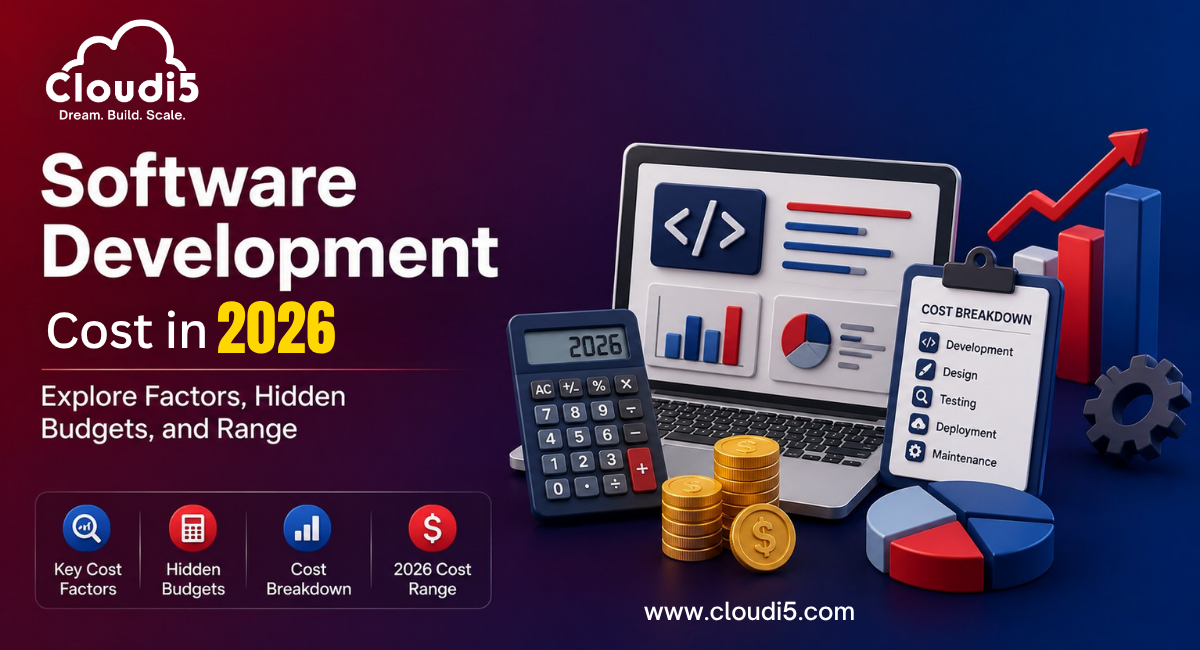
Software Development Costs In 2026: Explore Factors, Hidden Budgets, And Range
 Cloudi5 - Blogger
Introduction
Understanding software development costs could save you thousands!
One of the main problems that businesses need to deal with before investing in their software development projects is determining the budget required for the project. This applies to any type of software development, such as developing a mobile application, a website, an ERP system, CRM, or anything else. Nowadays, software development is not just an additional element of the business but its main tool for growth, productivity, and client interaction. It doesn't matter whether you are a startup looking for a way to grow or a big enterprise trying to launch an AI-driven platform – understanding software development costs in 2026 is vital if you want to allocate your budget right. The evolution of technologies and innovations give a chance to develop better and faster; they also imply some extra costs, which you should consider before beginning the work.
At Cloudi5 Technologies, we offer transparent pricing and software development packages in 2026 that will help us cover all hidden fees and post-maintenance fees, as well as training fees and implementation periods.In this Blog, You will know what truly impacts software development costs in this year, what realistic price ranges are depending on projects and other hidden costs that companies usually hide. So, how to reduce costs without lowering quality standards? If you are a startup founder and preparing your first product, a marketing manager who evaluates vendor proposals, or simply curious about what you pay for, this one is for you!
Why the "Cost of Software" Question Never Has One Answer ?
Ask what the project cost is, and you'll likely get three different numbers — and all three could be right, depending on what they're building it with. A custom school management system or ERP built around one institution's exact workflow is a different asset from a template website with a contact form. So is a full-blown multi-vendor e-commerce platform with vendor dashboards, commissions, and payment splits, compared to a basic online catalog.
Same word — "software" — completely different amount of engineering behind it. That's really the whole story.
| Type of Software | Estimated Timeline | Estimated Cost Range | Ideal For |
|---|---|---|---|
| Simple Software | 1–3 months | $25,000–$50,000 | Startups, proof of concept |
| Medium Software | 3–9 months | $50,000–$250,000 | Growing businesses, automation |
| Complex Software | 9+ months | $250,000 and above | Large enterprises, industry-specific solutions |
What Actually Drives the software development price?
Complexity, mostly
Every added feature is another piece that has to be built, tested, and maintained — and that adds up fast. A simple idea stays budget-friendly; an ambitious one rarely does.
The platform you choose
Native iOS, Android, cross-platform, or web — each comes with its own price tag. Building for two platforms at once almost always costs less than building twice.
Overall design complexity
A clean template is fast and affordable. A fully custom UI, on the other hand, means more design rounds, more revisions, and more billable hours.
Level of custom features involved
Login and a contact form? Cheap. Real-time chat, payments, or AI-driven recommendations? That's a different budget entirely.
Who's building it?
A freelancer, a Professional agency, or a large firm will all quote you differently for the same project. You're not just paying for code — you're paying for experience, process, and accountability.
What happens after launch ?
Development is only half the bill. Hosting, updates, bug fixes, and security patches keep costing money long after the app deployment.
| Web App Type | Timeline | Cost Range | Examples |
|---|---|---|---|
| Simple business website with CMS | 2–6 weeks | $5,000 to $20,000 | Landing pages, portfolio sites, blogs |
| E-commerce platform | 3–6 months | $50,000 to $200,000 | Product catalog, cart, payments, and admin panel |
| Web portal or dashboard | 3–5 months | $40,000 to $150,000 | User accounts, data visualization, and reporting |
| SaaS application
|
6–12 months | $100,000 to $500,000 | Multi-tenant platforms, subscription billing, API access |
| Enterprise web application
|
9–14 months | $200,000 to $800,000+ | Enterprise resource planning (ERP) systems, healthcare portals, and financial platforms |
What Truly Influences Software Development Expenses in 2026?
There is a limited set of factors that goes into any software development estimate, yet it is about knowing how much each one of them influences the bottom line. Project complexity is the key one – an entry-level booking application will be much cheaper to develop than the system allowing multiple users to sync data in real time. The tech stack is another important component, as some frameworks offer better performance, faster development, and lower costs, while others promise scalability and high quality at higher initial expenses.
Integration complexity, which implies connecting payment gateways, third-party APIs, and existing business systems, is also among factors influencing software development expenses, as well as the need to make the project comply with certain rules and secure the data when it works with the latest versions.
Hidden Costs Most Businesses Aren't Thinking About!
This is where people always give me the most confused looks because discussions about costs usually end at the development stage and completely overlook anything else. Maintenance is one of the major issues because software doesn't stop at its development and needs frequent upgrades, bug fixes, and compatibility patches, which generally cost an additional 15-20% of the build price per year.
Third-party API and licensing fees are also something to watch out for because payment gateways, email/SMS, cloud-hosting, and analytic tools require recurring subscriptions, but aren't included in the initial quote. Testing and quality assurance of any software product that handles user information is essential.
Security audits and compliance tests have become a must by 2026, especially for products used in educational, healthcare, or financial sectors. And, of course, scaling infrastructure costs money too, because a server configuration that works well with 500 users may require an upgrade when there are 5,000 of them. The last source of budget overrun is mid-project changes – the client coming up to you half-way into the project and saying that they would like a certain feature added. This is the most common reason for budget overruns and, at the same time, underestimated one.
In-House Team vs Agency vs Freelancers — Cost Comparison
Each hiring model trades cost for control, and picking the wrong one for your project size is a common budgeting mistake.
An in-house team gives you the tightest communication and the most control, but it's also the expensive option once salaries, benefits, and recruiting time are factored in. It makes sense only for companies where software is the core, long-term product.
Outsourcing to an established Software development agency sits in the middle — you get a full team already in place, at a lower overall cost, especially in a competitive market in India. You trade a bit of day-to-day control for the agency's process.
Freelancers are usually the cheapest upfront, which works well for small, well-scoped projects. The risk is inconsistent availability and little to no structured QA or post-launch support. The right pick depends on project size and how central the software is to your business.
Cost by Development Approach — Custom Build vs Low-Code vs Off-the-Shelf
How you build matters as much as what you build.
Custom development gives you a product built exactly to your requirements — full flexibility and ownership, but also the most expensive and time-intensive route. Worth it mainly when your processes are unique.
Low-code/no-code platforms have matured into a solid middle ground — faster, cheaper, and flexible enough for many mid-sized needs, with some trade-off in long-term scalability.
Off-the-shelf software is the fastest, cheapest way to get moving — which is exactly why many institutions now prefer ready-made school management software over custom builds. Attendance, fee management, and parent communication come built-in, tested, and updated by the provider. For a deeper look at what to expect, see our breakdown of the best school management software - Features & tools.
The smart move: use off-the-shelf where standard workflows already exist and save custom development for what actually makes your business different.
Conclusion
The factors that will influence the price of developing software in 2026 are not limited only to the development hours. The complexity of the project, technologies used, special features implemented, integration, security measures, testing, maintenance, and other aspects of the project greatly affect its total price. Whatever kind of software project you wish to develop – whether a startup MVP, website for a company, mobile application, or an enterprise solution – picking a proper software development partner is equally important to setting a proper budget. That is where we come into the picture at Cloudi5 Technologies. We help companies to develop top-notch software solutions.
If you are ready to calculate the price of developing your next software project,Contact our team today for a personalized consultation and an accurate cost estimate.
Frequently asked Questions:
1. How much would software cost in 2026?
It depends on complexity, platform, and people involved — there is no definite number.
2. What's Cloudi5 special service for cost transparency?
Upfront cost breakdown covering build, third-party tools, and post-launch support.
3. What is the most important cost to be aware of?
Maintenance — around 15-20% of the build cost, each year after release.
4. Do third-party apps add cost?
Yes, payment gateways, hosting, and APIs use additional subscriptions.
5. What makes Cloudi5 pricing different?
Transparent packages covering hidden fees, maintenance, and implementation — no surprise costs later.
6. Are freelancers a risk to software development projects?
Not for small, simple tasks; support and testing may not be available.
7. Custom software or out-of-the-box product – what’s better?
Out-of-the-box software for general requirements; custom software only if needed.
8. Why do projects go over planned budget?
Scope creeps during the development process – adding one “small” feature makes it grow.
9. Is compliance still required today?
Yes, if it’s healthcare, financial, or educational software in 2026.
10. What should I do to protect myself from unexpected costs?
Request an estimated price breakdown of developer’s charges on separate items.
CONNECT
-

Share
don't miss
Trusted By






Leave Comments