




Use AI to summarise this article
Operating an online store involves more than just creating a website and waiting for sales. To truly progress, you need to understand what works and what doesn't. Here's where e-commerce KPIs come in. These metrics allow you to assess success, improve performance, and make more informed business decisions. Many business owners get confused when they hear concepts like conversion rate or client lifetime value. The good news is that you don't have to be a data specialist to understand them.
In this blog, Cloudi5 Technologies presents ecommerce performance metrics in simple language that even beginners may understand.
What are e-commerce KPIs?
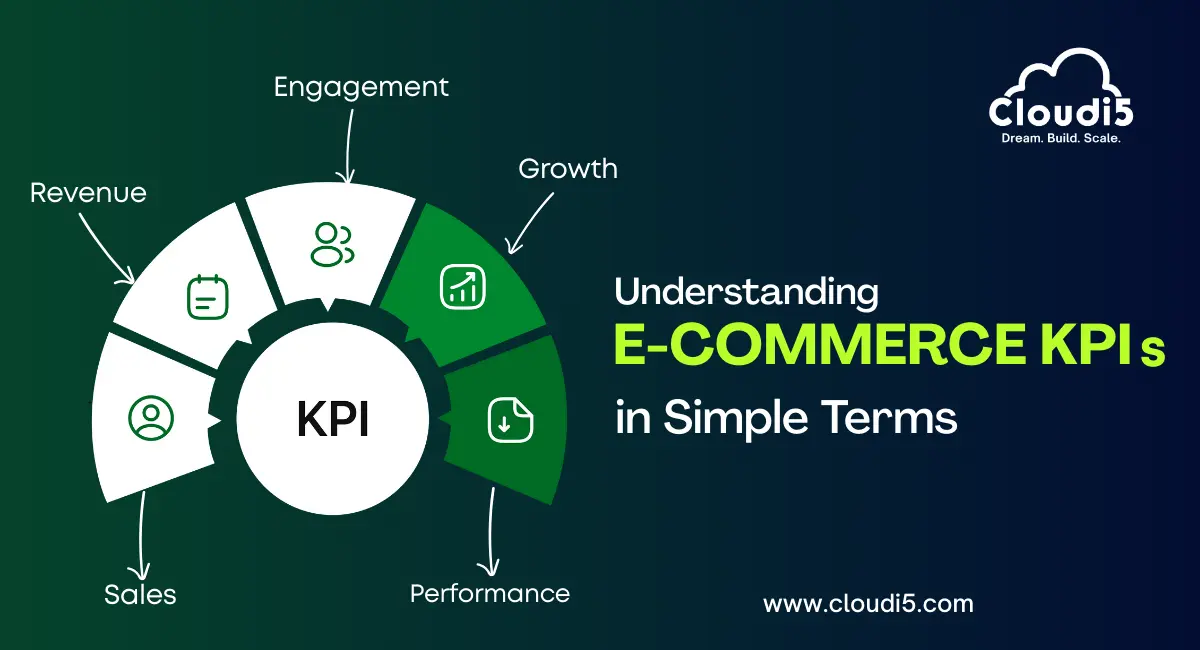
E-commerce KPIs, also known as key performance indicators in ecommerce, are numbers that indicate how well your online store is operating. These numbers assist you in understanding consumer behaviour, sales performance, and marketing outcomes.
In simple terms, ecommerce metrics and KPIs address questions such as:
- Are people visiting my website?
- Are they buying products?
- Am I making a profit?
For any online business, tracking e-commerce KPIs for beginners is the first step towards expansion.
Why are e-commerce KPIs important for your business?
Without KPIs, you're guessing rather than making decisions. When you track e-commerce performance metrics, you can easily understand what needs to be improved.
Here's why KPIs matter:
- They assist in measuring business growth.
- They demonstrate how customers act on your website.
- They improve marketing and sales strategies.
- They help to reduce losses and improve earnings.
At Cloudi5 Technologies, we help businesses use data to make better decisions instead of making assumptions.
Most Important Ecommerce KPIs You Should Track:
These are the most important ecommerce metrics and KPIs that every business should understand:
Conversation Rate:
This indicates how many visitors actually purchase something. If 100 individuals visit and two make a purchase, your conversion rate is 2%.
Average Order Value (AOV):
AOV indicates how much a customer spends per order. Increasing this improves income without expanding traffic.
Customer Acquisition Cost (CAC):
This shows how much money you spend to get a single consumer through advertising or marketing.
Customer Lifetime Value (CLV):
CLV tracks how much a customer spends over time. Higher CLV indicates superior long-term growth.
Cart Abandonment Rate:
This shows how many customers add things to their cart but do not complete the transaction.
These key performance indicators for e-commerce provide a clear view of store health.
Many online stores lose sales as a result of unsuccessful transactions, as discussed in our blog "How to Reduce Payment Failures in E-commerce?", which teaches how to solve these problems efficiently.
E-commerce KPIs Explained with Simple Examples:
Let's make it even easier by providing examples:
- If 1,000 users visit your website and 20 make a purchase, your conversion rate is 2%.
- Your average order value (AOV) is calculated at ?2,000 per order.
- If you spend ?500 on marketing to gain one consumer, this is your cost per acquisition (CAC).
Understanding e-commerce KPIs for beginners becomes simple when data is linked to real-world scenarios.
Sales KPIs vs Marketing KPIs in E-commerce:
Sales KPIs focus on income and orders, whereas marketing KPIs concentrate on traffic and promotions.
Sales KPIs include,
- Conversion rate
- Revenue
- Average order value
Marketing KPIs include:
- Website traffic
- Click-through rate
- Return on Ad Spend (ROAS)
Our skilled e-commerce website development company in Coimbatore, Cloudi5 Technologies, assists businesses in balancing sales and marketing KPIs for consistent growth.
How to Track E-commerce KPIs Easily?
To track e-commerce performance metrics, simple tools are sufficient. Some prominent alternatives are:
- Google Analytics
- Google Search Console
- Shopify or WooCommerce dashboards
- Ad platforms like Google Ads and Meta Ads
Cloudi5 Technologies uses these techniques while developing online stores, making KPI tracking simple and effective.
Common Mistakes Businesses Make While Tracking Ecommerce KPIs:
Many businesses do not benefit from KPIs because of the following common mistakes:
- Tracking too many metrics at once
- Ignoring customer behaviour
- Not reviewing KPIs regularly
- Focusing only on traffic, not conversions
A trusted e-commerce website development company in Coimbatore makes sure the appropriate KPIs are tracked depending on business objectives.
Many beginners fail to measure the correct metrics, which is one of the common mistakes mentioned in our blog, "10 Mistakes to Avoid When Starting Your First E-Commerce Business".
Which Ecommerce KPIs Matter Most for Beginners?
If you're just getting started, focus on these:
- Conversion rate
- Website traffic
- Average order value
- Cart abandonment rate
These ecommerce KPIs for beginners provide sufficient knowledge without overloading you. Cloudi5 Technologies usually supports starting small and scaling KPIs as the business expands.
Conclusion:
Understanding ecommerce KPIs does not have to be complex. When communicated clearly, e-commerce metrics and KPIs may be great tools for success. They help businesses to track performance, improve user experience, and earn revenue.
Whether you're starting a new business or scaling an existing one, tracking the correct ecommerce performance metrics is essential. As the best ecommerce website development company in Coimbatore, Cloudi5 Technologies helps businesses in creating data-driven online stores that grow faster and smarter.