



Use AI to summarise this article
What Is Jamstack and Why Are Developers Switching to It?
The web development world is changing fast. Slow-loading websites, frequent security breaches, and high server costs are pushing developers to look for smarter solutions. That is exactly where Jamstack comes in, a modern approach that is quietly becoming the go-to choice for developers around the world.
In this post, we break down everything you need to know about Jamstack: what it is, how it works, why developers love it, and whether it is the right fit for your next project.
Table of Contents:
- What Is Jamstack?
- How Does Jamstack Architecture Actually Work?
- What Do JavaScript, APIs, and Markup Mean in This Context?
- What Are the Real Benefits of Jamstack for Businesses?
- How Is Jamstack Different from Traditional Web Development?
- Which Jamstack Frameworks and Tools Are Worth Knowing?
- Is Jamstack the Future of Web Development?
- FAQs
1. What Is Jamstack?
Simply put, what is Jamstack? It is a web development approach where websites are pre-built as static files and served directly from a CDN (Content Delivery Network), instead of being generated by a server every time a user visits.
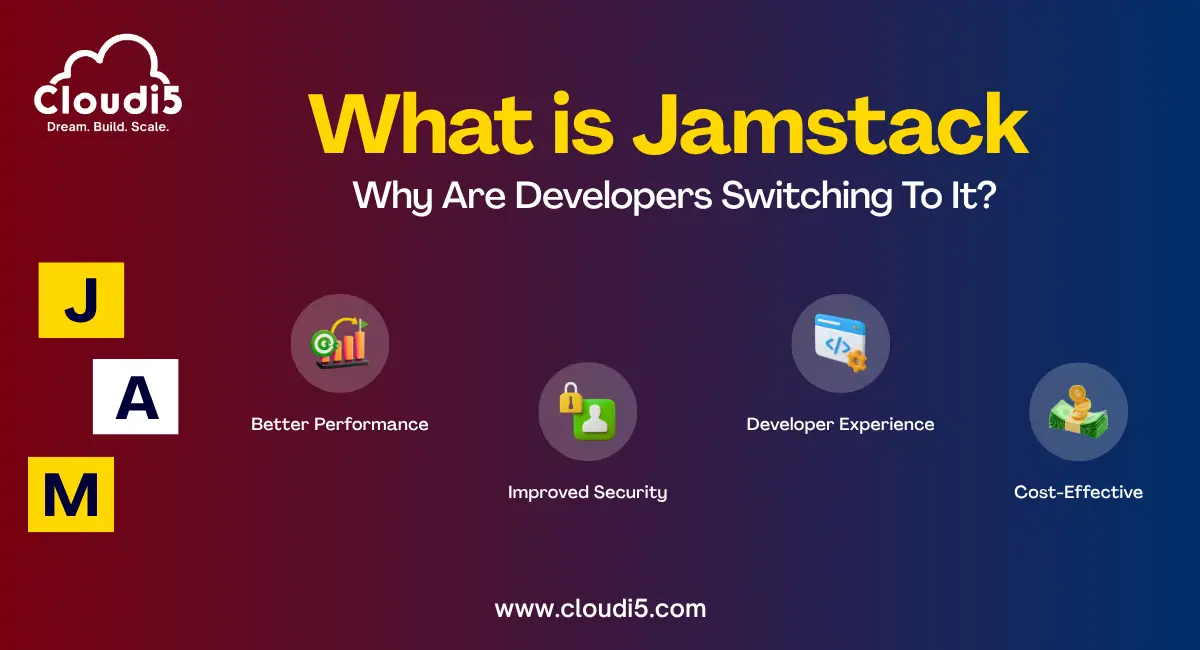
The name itself tells the whole story: JavaScript, APIs, and Markup, three building blocks that work together to create fast, secure, and scalable websites.
Unlike traditional web apps that depend on a back-end server running live for every request, Jamstack sites are pre-rendered at build time. This means your users always get a lightning-fast response, no matter where they are in the world.
At Cloudi5 Technologies, we have been helping businesses in Tamil Nadu adopt modern web architectures and Jamstack has been one of the most impactful shifts we have introduced to our clients.
2. How Does Jamstack Architecture Actually Work?
Understanding Jamstack architecture is simpler than it sounds. Here is how the process flows:
- Build time – Your website is compiled into static HTML, CSS, and JavaScript files before anyone visits it.
- CDN delivery - These pre-built files are stored across multiple global servers (CDN nodes), so pages load from whichever server is closest to the user.
- API calls – Dynamic features (like login, payment, or real-time data) are handled through third-party or custom APIs called directly from the browser.
- No origin server dependency - Because pages are already built, there is no server processing requests in real time.
This model is what makes Jamstack architecture so different and so effective. The site does not "think" on every request. It simply delivers. As a leading web development company in Coimbatore, Cloudi5 Technologies has implemented this model for businesses that need reliability at scale.
If you are new to this concept, our detailed breakdown of Static Websites vs Dynamic Websites will help you understand the core difference before diving deeper into Jamstack.
3. What Do JavaScript, APIs, and Markup Mean in This Context?
The term JavaScript APIs Markup is more than just an acronym; it describes how a Jamstack site is actually built:
- JavaScript handles all the dynamic and interactive behaviour on the client side, things like animations, form handling, and fetching live data.
- APIs act as the bridge between the front-end and back-end services. Whether it is a payment gateway, a CMS, or a database, everything communicates through APIs.
- Markup refers to the pre-built HTML content generated at build time through static site generation. Tools like Next.js, Gatsby, and Astro compile your pages in advance so they are ready to serve instantly.
Together, these three layers create a clean separation between presentation and logic, which is the core reason Jamstack sites are so performant and maintainable.
4. What Are the Real Benefits of Jamstack for Businesses?
This is the section most business owners care about. The Jamstack benefits are not just technical, they have direct business impact:
Speed and Performance:
- Pages load in milliseconds because there is no server processing involved.
- Faster load times directly improve user experience and Google rankings.
- Core Web Vitals scores improve significantly with static delivery.
Security:
- No live database or server exposed to the internet means a smaller attack surface.
- Common vulnerabilities like SQL injection and server exploits simply do not apply.
Scalability:
- Because files are served from a CDN, your site can handle thousands of simultaneous visitors with zero extra infrastructure.
- Traffic spikes, like during a product launch, will no longer crash your site.
Lower Hosting Costs:
- CDN hosting is considerably cheaper than maintaining a traditional server.
- Platforms like Netlify and Vercel offer generous free tiers for smaller projects.
Better SEO:
- Fast-loading, pre-rendered pages are crawled and indexed by Google more efficiently.
- Better performance signals lead to higher rankings over time.
The Jamstack benefits are especially valuable for startups and growing businesses that need enterprise-grade performance without enterprise-level infrastructure costs.
5. How Is Jamstack Different from Traditional Web Development?
| Feature | Jamstack | Traditional Stack |
| Page delivery | Pre-built via CDN | Generated by server per request |
| Speed | Very fast | Depends on server load |
| Security | High (no live server) | More vulnerable |
| Scalability | Effortless | Requires server upgrades |
| Hosting cost | Low | Higher |
| Dynamic features | Handled via APIs / serverless functions | Built into the back end |
The biggest difference is where the "thinking" happens. Traditional sites think at request time. Jamstack sites think at build time, and that shift changes everything.
Serverless functions fill the gap for truly dynamic needs. They are small, on-demand code snippets that run in the cloud only when needed, perfect for handling form submissions, user authentication, or API integrations without maintaining a full back-end server.
6. Which Jamstack Frameworks and Tools Are Worth Knowing?
If you are exploring Jamstack, here are the most popular tools used today:
Frameworks:
- Next.js - The most widely adopted Jamstack framework; great for hybrid static and dynamic sites.
- Gatsby - Excellent for content-heavy websites with rich plugin ecosystems.
- Astro – A newer framework focused on delivering minimal JavaScript to the browser.
- Nuxt.js - The Vue.js equivalent of Next.js, ideal for Vue developers.
Hosting Platforms:
- Netlify - The platform that popularised Jamstack; easy CI/CD and global CDN.
- Vercel - Optimized for Next.js deployments with excellent developer experience.
CMS Options:
- Contentful, Sanity, and Strapi are headless CMS tools that feed content to your Jamstack front end via APIs.
If you are based in Tamil Nadu and want expert help choosing the right stack, our team can guide you through the right combination of tools for your business needs.
If you are choosing a JavaScript framework for your Jamstack project, check out our comparison of ReactJS vs VueJS.
7. Is Jamstack the Future of Web Development?
All signs point to yes. Developer surveys consistently show growing adoption. Major companies, including Nike, Smashing Magazine, and Twilio, have already moved parts of their platforms to Jamstack.
For businesses in India, particularly those working with a web development company in Coimbatore, this shift represents an opportunity to build websites that are faster, safer, and cheaper to run than ever before.
That said, Jamstack is not the right choice for every project. Highly dynamic platforms like social networks with real-time feeds or complex e-commerce with personalised pricing may need a hybrid or traditional approach. A good agency will always recommend what fits your specific goals, not just what is trendy.
At Cloudi5 Technologies, we evaluate your business needs first and recommend the architecture that delivers the best long-term results, whether that is Jamstack, a hybrid approach, or a traditional setup.
FAQs:
1. Do I need coding knowledge to use a Jamstack website?
No. Once built, managing content on a Jamstack site is done through a headless CMS, which works just like a simple dashboard. No coding required for day-to-day updates.
2. Is Jamstack suitable for e-commerce websites?
Yes, with the right tools. Platforms like Shopify (headless) or Snipcart integrate smoothly with Jamstack sites to handle products, cart, and payments.
3. How long does it take to build a Jamstack website?
It depends on the complexity. A standard business website typically takes 2–4 weeks. Larger projects with custom integrations may take longer.
4. Will a Jamstack site rank well on Google?
Yes, Jamstack sites often outrank traditional sites because they load faster and score higher on Core Web Vitals, which are key Google ranking factors.
5. Can I migrate my existing WordPress site to Jamstack?
Absolutely. WordPress can be used as a headless CMS, with your content served through a Jamstack front end. It gives you the best of both worlds, familiar content management with modern performance.
Conclusion:
Jamstack is not just a trend; it is a smarter way to build for the modern web. Faster load times, stronger security, lower costs, and effortless scalability make it a compelling choice for businesses of all sizes. Whether you are launching a new site or rethinking an existing one, Jamstack is worth serious consideration.