



Use AI to summarise this article
Introduction
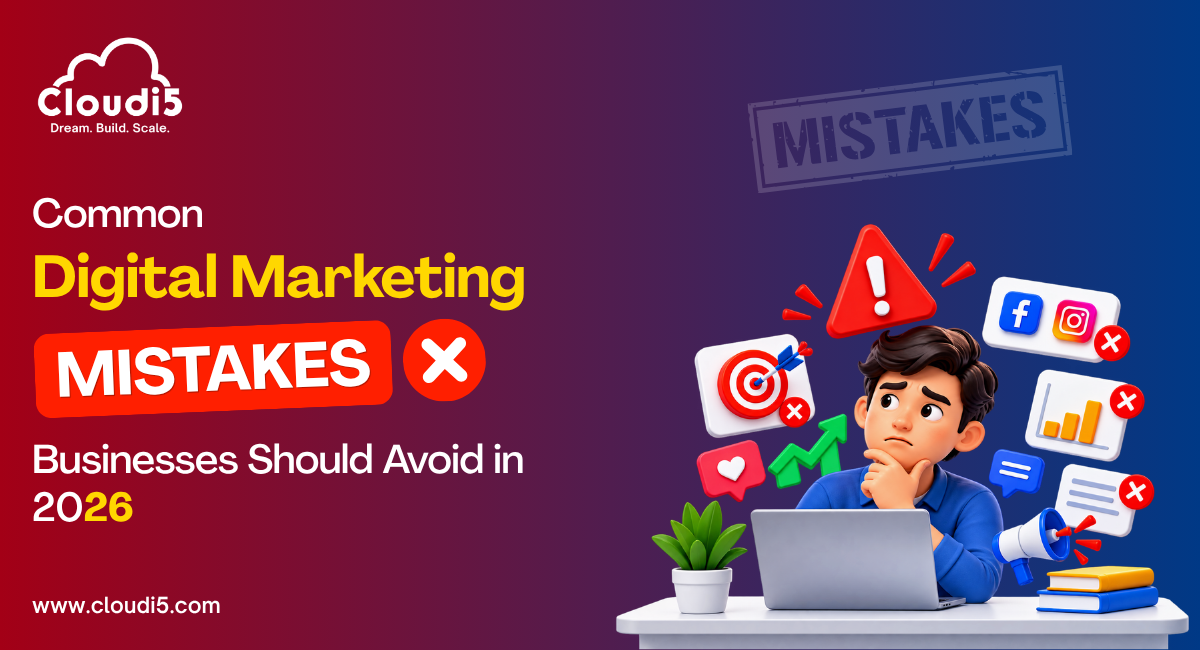
AI is shaping digital marketing with innovations like AI Overviews, answer engines, short videos, automation, and data-centric strategies. However, amidst all these developments and changes, businesses may miss out on visibility, leads, and conversions due to some common errors, such as neglecting AI search, over relying on AI-generated content, poor strategies, lack of a good mobile experience, untimely or untargeted ads, and inconsistency in branding. In 2026, avoiding digital marketing mistakes becomes important for firms. Cloudi5 Technologies assists companies in adapting to new digital trends and adopting strategies that center around visibility, engagement, and conversions.
10 Common Digital Marketing Mistakes Businesses Should Avoid in 2026
These mistakes can make it harder for businesses to reach the right customers, generate quality leads, build trust, and turn online marketing efforts into measurable business growth.
1. Marketing Without a Clear Strategy or Goals
Another common digital marketing mistake is launching marketing activities without defining what the business aims to accomplish. Posting, advertising, or blogging in general without having set objectives can become difficult to assess the results.
A business needs to set its target audience, marketing objectives, customer journey, and KPIs. For example, a lead generation campaign may have a particular focus on qualified leads and conversion rates, and an awareness campaign may focus on reach and engagement. A practical digital marketing strategy in 2026 should connect every activity with a measurable business objective.
Businesses need to define:
- Target audience and customer segments
- Marketing objectives
- Right channels to use digitally
- Content strategy
- Budget for advertising
- Conversion targets
- KPIs and reporting approach
A clear strategy also helps businesses decide where to invest their time and budget instead of trying every marketing channel at once.
Real-world example: Nykaa tested broader generic search terms such as product-category keywords instead of relying only on branded searches. The company used a controlled geographic experiment to evaluate incremental results, showing why testing and measurement should be part of the strategy rather than an afterthought.
2. Ignoring AI-Driven Search, GEO, and AEO
Search has evolved from traditional Google ranking results to encompass AI answers, AI Overviews, conversational search, and answer engines. One significant mistake lies in concentrating solely on traditional SEO rankings, whereas completely ignoring GEO and AEO. Businesses need to consider creating easily understandable and readable content for search engines and AI-fueled systems alike. It involves answering queries, adding titles, providing valuable information, proving your expertise, and creating logically structured content. The aim is not to give up on SEO. Rather, companies should develop a more broader search strategy that takes into account traditional searches, answer engines, and AI-based searches. Read our blog on AEO Vs GEO Vs SEO to understand the differences between SEO, AEO, and GEO.
3. Over-Relying on AI-Generated Content
The usage of AI technology can assist marketers in researching the topic, generating ideas, writing drafts, and increasing efficiency. Still, there is yet another significant mistake that companies make by creating excessive quantities of AI-generated material without any human evaluation. The content created using AI can be repetitive when no original thoughts, industry experience, examples, or even company voice are incorporated into it. Businesses should use AI as a supporting tool rather than treating it as a complete replacement for human expertise.
Effective content should:
- Serve an actual need of the target audience
- Offer new ideas or examples
- Show the expertise of the brand
- Undergo verification and editing
- Have the tone and voice of the company
- Give useful information
- Prevent redundancy
The key is to combine AI efficiency with human judgment, creativity, and expertise.
4. Neglecting Mobile-First Design and User Experience
Even though a business can draw in visitors via SEO, social media, or even advertising, it will fail to retain them if its website is poorly designed. Pages that take too long to load, navigation that’s hard to use, tiny fonts, unnecessary distractions, and ambiguous action prompts can discourage visitors from taking the next step. Mobile-first design should therefore be an important part of a modern digital marketing strategy. Businesses should regularly check how their websites perform across smartphones, tablets, and desktops.
Critical items for review include:
- Speed of page load
- Site navigation
- Readability
- Web Vitals
- Contact forms
- Calls to action
- Landing page experience
Website optimization is particularly crucial since marketing traffic will eventually have to go through the website before becoming leads and customers.
Real-world example: Paisabazaar tested faster mobile landing pages for Search campaigns in India. In its experiment, the AMP version delivered 60% faster load times and a 10% incremental increase in conversions, illustrating how technical website experience can affect marketing performance.
5. Running Ads Without Proper Targeting and Optimization
It is easy to gain quick visibility through paid advertisements, but spending money without an effective strategy to target and optimize can lead to poor budget utilization. Organizations often concentrate more on developing and rolling out their campaigns than knowing whom they are targeting, what message to convey to them, and what actions they are expected to perform. Ad platforms are becoming increasingly automated as well. This underscores the importance of having clear campaign objectives and proper conversion tracking. Businesses should treat advertising as an ongoing optimization process rather than a one-time campaign setup. Check out our blog on Meta Ads: What Changed & What Still Works? to learn the recent changes in Meta advertising, including automation, creative testing, and the growing importance of conversion-focused measurement.
Real-world example: Bird & Blend Tea Co. used Google Ads across Search and Performance Max while focusing on new-customer acquisition and conversion goals. Google reports that the brand generated 439% ROAS in 2023 and grew new-customer sales by 320%, showing the importance of connecting ad activity with measurable business outcomes.
6. Overlooking Local SEO and Google Business Profile
Companies operating in particular cities or regions must not neglect local search presence. One of the mistakes companies make is that they create a Google Business Profile and leave it unattended. Incorrect or insufficient information about your company, its categories, photos, lack of reviews, or their inconsistency will negatively affect your business's credibility.
Businesses should focus on:
- Right information about your business
- Correct photos
- Reviews of your clients
- Keywords that work in your area
- Contact information consistent with all other resources
Such local SEO strategies may be helpful for the companies which target people in particular locations.
7. Inconsistent Social Media, Content, and Brand Messaging
Another common error includes being inconsistent in messages across various digital media platforms.
For example, a company's website may have a formal tone; its social media posts might convey something entirely different. Lack of consistency in visuals, message, and positioning may lead to confusion regarding the organization's identity.
It is essential that organizations create a set of guidelines for:
- Brand voice
- Visual identity
- Themes of content
- Posting style
- Communication with audience
Consistency does not involve sending out the same message everywhere. Rather, the same message could be modified depending on which channel is involved. Short-form videos, educational content, customer-oriented content, and industry updates can be shared consistently through various social media platforms while maintaining a consistent brand identity.
8. Failing to Prioritize Data Privacy, First-Party Data, and Tracking
Data can play a significant role in making sound decisions for digital marketing, but companies should be careful with their handling of customer information. The failure to consider the importance of data privacy, data consent, and data accuracy may impact the level of trust of customers and make measuring campaign performance more complicated.
Companies should use proper methods of collecting data and inform customers about how their data will be used. The use of first-party data collected via web forms, e-mail subscriptions, customer interactions, and transactions can be more insightful than third-party data. Regularly reviewing tracking setups and privacy practices can help businesses maintain accurate reporting, protect customer information, and make better marketing decisions.
9. Ignoring Email Automation and Conversion Optimization
Getting visitors to a website and obtaining their contact information is just a part of digital marketing. Businesses need to provide the proper way forward for visitors and potential clients. Bad call-to-action, disorienting landing pages, long forms, and impersonal follow-up emails will lower the conversion rate, though the business gets the right kind of visitors. This is where conversion rate optimization (CRO) and email automation come into play.
Here are the ways businesses can improve the conversion rate:
- Creation of relevant calls-to-action
- Lead forms optimization
- Email audience segmentation
- Personalization of follow-up emails
- Email campaigns automation
- Optimization of headlines and calls-to-action
- Conversion rate monitoring
Email automation helps businesses maintain contacts with prospects in the customer journey, while CRO makes visitors' actions easier. The idea is not just to increase traffic, but to make something useful happen after visitors get to a site.
Real-world example: E-commerce agency Neuralab implemented welcome and abandoned-cart automations for Wow Junkie. The automations were designed to provide relevant information at useful points in the customer journey rather than relying only on broad email blasts.
10. Skipping Analytics and Focusing on Vanity Metrics
Companies are interested in likes, followers, impressions, and site visitors without evaluating if these metrics have helped the business achieve its goals. Though vanity metrics seem good, they do not necessarily show effective marketing. Companies need to measure relevant metrics that include qualified leads, conversion rate, cost per lead, customer acquisition cost, and ROI.
Tools such as Google Analytics and Google Search Console can be used to determine the channels that bring in quality visitors and leads. By constantly analyzing the data, companies can optimize their digital marketing efforts and make informed decisions about business outcomes. Read our blog on AI-Based Lead Scoring & Conversion Optimization for further context on using data and lead quality to improve conversion performance.
Real-world example: Tanishq used store-sales measurement together with first-party sales data to connect digital advertising with offline outcomes. Google reports that this helped the brand quantify offline impact and increase offline sales by 7%, demonstrating why marketing measurement should connect with actual business results rather than stopping at clicks or impressions.
How Can Businesses Avoid These Digital Marketing Mistakes?
-
Define one primary business objective for each campaign.
-
Review how your brand appears across traditional search, AI-driven search, and answer-focused experiences.
- Use AI to improve efficiency, but review important content for accuracy, originality, brand voice, and usefulness.
- Test website speed, mobile usability, forms, landing pages, and calls to action regularly.
- Track conversions and lead quality, not only clicks, impressions, followers, or reach.
- Keep Google Business Profile and other local business information accurate and consistent.
- Use first-party customer data responsibly and review consent, privacy, and tracking practices.
- Automate appropriate follow-ups, but keep human support available for complex or high-value enquiries.
- Run experiments where possible and compare results against a clear baseline.
- Review performance regularly and reallocate budget toward channels and activities that support business goals.
Businesses can prevent some common mistakes in digital marketing by defining its goals, knowing its target market, and conducting regular evaluation of its marketing efforts. Changes in SEO, AI search engines, social media, online paid advertisements, and consumer expectations need to be followed up while focusing on growth-oriented marketing strategies. Collaborating with a professional digital marketing agency can also assist in ensuring that companies have a well-planned strategy, optimized campaigns, increased online presence, and measurable results. As a digital marketing company in Coimbatore, Cloudi5 Technologies offers digital marketing services that can assist organizations in enhancing their online presence, targeting the right audience, and converting leads effectively.
Conclusion
To succeed in digital marketing in 2026, avoiding typical errors will be an important step to take. It will enable organizations to create an efficient online presence. Some of the ways that organizations can achieve that include strategy, content, AI-driven SEO, advertising, analytics, and a focus on customers. Cloudi5 Technologies helps businesses strengthen their digital presence with practical, result-focused marketing strategies. Get in Touch to discuss your digital marketing goals and build a strategy that supports your business growth.
FAQs
Companies lack strategy, fail to implement SEO practices, mis-target their audience, and do not consider analytics.
Avoiding these errors will help increase visibility, engagement, leads, conversion rates, and ROI from marketing.
AI changes search, content creation, personalization, automation, and customer experience.
GEO helps optimize content for visibility in AI-generated search experiences.
Cloudi5 Technologies helps businesses improve online visibility, generate leads, and achieve measurable marketing results.
AEO assists businesses in providing answers directly through answer engines.
Mobile optimization makes a business more appealing, engaging, visible, and increases conversions.
They can optimize the Google Business Profile, use local keywords, and handle customer reviews.
It helps in identifying what works best for a business and making informed marketing decisions.
Cloudi5 Technologies provides practical digital marketing strategies focused on business growth and results.