



Use AI to summarise this article
Introduction
Search is evolving at an unprecedented rate. Individuals are not anymore depending exclusively on the regular search results from Google to obtain information, goods, and services. Rather, they are turning to more advanced search technologies, powered by artificial intelligence, that give direct answers to their queries. This change has made the optimization of AI search one of the essential aspects of SEO today. By 2026, all businesses will need websites that can be easily understood, interpreted, and trusted by both human and artificial intelligence systems. With the help of advanced website development combined with SEO for AI search engines, one can create a digital footprint that is more ready for 2026. We at Cloudi5 Technologies provide support for businesses in creating and optimizing modern digital experiences through web development, SEO, performance, and future technologies.
What Is AI Search Optimization?
AI search optimization involves the improvement of website content, structure, technology, and authority to ensure that the AI search system understands and may utilize your content in its generated response. SEO on the other hand mainly centers on ranking the webpages on the results pages of the search engines. AI search takes it a step further by understanding context, intent, entities, relationships, and content quality before giving an answer.
This implies that organizations need to think beyond the use of keywords. The website needs to have:
-
Quality information
-
Quality content structure
-
Topical relevance
-
Accuracy of information
-
User experience
-
Technical SEO
-
Structured data
-
Expertise and authority
As search evolves further, companies must also realize the importance of understanding how SEO, AEO, and GEO complement each other. Our guide on AEO Vs GEO Vs SEO helps business understand how these strategies can work together to improve visibility across traditional and AI-powered search experiences.
How Google AI Overviews and AI Search Are Changing Search in 2026?
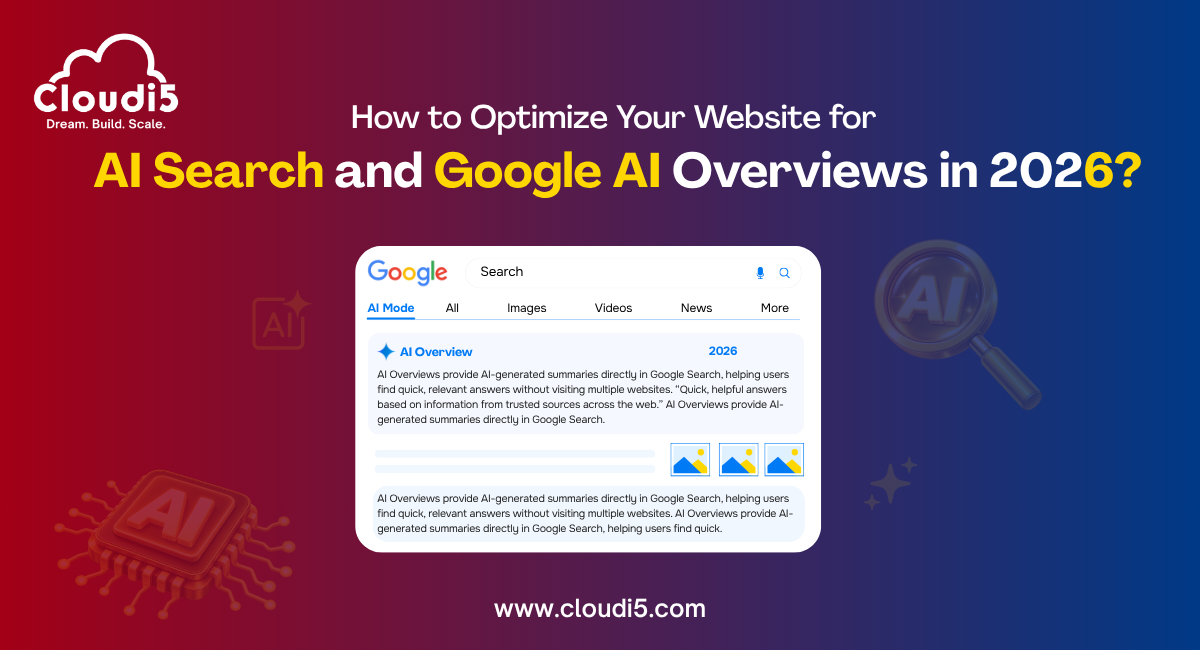
Google AI Overview is one of the tools which utilizes AI to generate summaries within searches. With this tool, it becomes easier for the user to grasp the concept that he or she is searching for without necessarily opening many individual websites. From the business perspective, this shifts the idea of search visibility to another level. The visibility of a page is not compromised by the fact that it can be cited as a source even when users start with an AI Overview rather than search results.
By 2026, the AI-based Google search is revolutionizing organic traffic flow in that users can get the information that they need right in the search results, which could result in zero-click searches. On the other hand, mentioning a brand in an AI Overview could aid in building the brand name. That makes visibility in AI-driven searches something to take into account for businesses. However, it is not an easy feat for companies to ensure that they feature on Google AI Overviews through any one optimization method. This is because Google decides what information is valuable and relevant to the specific search request. Companies should aim to create content that is:
-
Useful and unique
-
Specific to the search query
-
Easily understandable
-
Well-organized
-
Backed up by credible information
-
Search-friendly
It should be noted that AI-based search is also influencing organic search and paid search. By understanding these changes, you will be able to modify your marketing strategy if you use Google Ads or other paid campaigns. Our blog on AI Search And Paid Advertising: How Google AI Overviews Are Changing PPC provides additional insights on how AI-based searches are impacting paid marketing and why organic and paid approaches should increasingly be integrated.
How to Optimize Your Website for AI Search?
1. Build an AI-Friendly Website Structure
For an AI-ready website, there needs to be ease of parsing not only by crawlers but by language models as well. This means:
-
Well-formed headings (H1, H2, H3) based on how a user might formulate his question
-
Short and clear paragraphs that will answer the query posed right away
-
Simple HTML code without any heavy reliance on JavaScript
-
Speed and mobile-first design
An unorganized and out-of-date website architecture is the biggest barrier to AI visibility. In case your site has out-of-date structural features, bad navigation, or confusing content that cannot be easily understood by users or search engines, you should think about redesigning it. Check out our guide on Website Redesign: When And Why You Should Do It? to understand when updating your website structure can benefit your business.
2. Create Content That Directly Answers User Questions
Among the best ways to get ready for AI searches in 2026 is by knowing what information your target audience actually needs. Rather than just focusing on keyword searches, you need to focus on building websites based on questions. Descriptive headings should be used, and direct answers provided before further discussion. This strategy also promotes Answer Engine Optimization (AEO) as well since answer-based content is easy for search engines to understand and find.
3. Optimize for Conversational and Long-Tail Queries
AI search queries tend to be phrased in a more conversational tone compared to regular Google searches,using questions and natural language. Instead of key terms like “web development company,” an AI query may take the form of “What should I look out for in a web development company for my business?” In order to optimize your site for such searches, develop content based on long-tail keywords in question form that matches the way your customers will actually phrase their questions. Make sure you include conversational language in the heading and answer the questions in a straightforward manner. This way, you enable your website to give valuable responses to a more extensive number of conversation-based searches while making it easy to understand for your users and for AI-based search engines.
4. Use Schema Markup and Structured Data
Using schema markup in AI Overviews is yet another key technical factor in optimizing an AI-oriented website. Structured data makes it easy for search engines to determine what information is available on the webpage. For different types of pages, businesses can use structured data in the form of:
-
LocalBusiness
-
Article
-
Product
-
Service
-
FAQ
Structured data is just one component for making your site search engine-friendly. Having an easily understood structure, good navigation, and clear text will also help users comprehend the information provided. In this blog, The Best Ways To Design A Website provides more guidance on creating an effective website structure and user experience.
5. Strengthen E-E-A-T Signals
AI-enabled search engines require accurate data. Therefore, companies need to establish experience, expertise, authority, and credibility.
Strengthen these signals by:
-
Properly displaying author credentials
-
Showing proof of industry knowledge
-
Incorporating credible sources when needed
-
Updating information regularly
-
Having well-defined service and company pages
For companies trying to compete in saturated industries, being authoritative is as essential as optimizing keywords.
6. Improve Technical SEO and Website Performance
Good content requires a strong technical base for performance in the search engine. Concentrate on the crawling architecture, XML sitemaps, robots.txt, canonical URLs, HTTPS, mobile usability, good URL structures, internal links, and rich snippets. The website speed is also important. Improve image optimization, minimize unneeded scripts, use proper coding, choose quality hosting, and boost Core Web Vitals for a fast website experience. With the help of technical SEO along with good performance on the website side, businesses can enhance the user experience as well as help search engines and AI systems understand websites.
7. Consider an llms.txt File and AI Crawler Access
As the robots.txt instructs traditional crawlers on how to crawl the website, an upcoming llms.txt provides instructions for AI crawlers on how to interpret and access the content of the website. It is important to ensure that the AI crawlers such as GPTBot and Google-Extended are not blocked in the robots.txt if you want your content eligible for AI Overviews and LLM citations.
How to Rank in Google AI Overviews?
There is no proven formula to rank in Google AI Overviews. Google decides what information is valuable for each search individually, and AI-powered search results can differ based on the intent behind the search. Businesses should not attempt to influence the AI Overviews; rather, they should ensure that their content is clear, credible, technically accessible, and valuable. It can also be helpful for businesses to know how Google evaluates and categorizes information. Read our blog on Google's Secret Search Algorithm Leaked: All You Need To Know to get more insights on how Google evaluates.
A strong strategy should involve:
-
Search intent analysis.
-
Content creation that is both unique and valuable.
-
Question answering.
-
Establishing topic authority.
-
Proper usage of structured data.
-
Optimization of technical SEO.
-
Improvement of E-E-A-T signals.
-
Establishment of internal links that are relevant.
-
Updating of content.
-
Brand building.
Why AI Search Optimization Matters for Businesses in 2026?
Customer search has been changing. While traditional search results are still crucial, users are increasingly using AI-driven searches to learn more about products, services, organizations, and solutions. Firms that develop solid groundwork now could well be better equipped to cope with this new type of search environment. This will involve the development of a website which includes AI search optimization, SEO, AEO, GEO, technical SEO, structured data, valuable content, and user experience. At Cloudi5 Technologies, we assist companies in building websites that are built based on performance, usability, SEO and digital growth. The web designing services in our company are aimed towards building responsive, SEO-friendly, and business-centric websites, while web development services offer scalable and secure web solutions.
Conclusion
Search optimization by artificial intelligence has been identified as an integral component of the search strategy of the future in 2026. Organizations need to be aware of the fact that AI search is not the substitute of SEO, and instead SEO, AEO, and GEO should go hand in hand. Every aspect of your website, from creating valuable content and adding schema markup for AI Overviews to optimizing your technical SEO, website speed, internal links, and brand authority, influences how well search engines can comprehend your business. Cloudi5 Technologies assists companies in creating contemporary, SEO-compatible, and AI-enabled digital solutions. If you are looking to optimize your website for AI search, Contact Us today and let our experts help you build a stronger digital presence.
FAQs
AI search optimization optimizes your website to enhance its visibility within AI-driven searches.
Google AI Overviews offer AI summaries within the search results.
Creating useful content, optimizing SEO, using structured data, and answering questions will do just fine.
The secret is to focus on quality, trustable content and SEO basics.
Yes, Cloudi5 Technologies can improve website's SEO, structure, content, and technical performance.
GEO is used for optimizing the content to make it visible on AI search engines.
AEO makes the content provide answers to the queries posed by users in search.
It will help in making your content understood by the search engine.
No, it will complement the SEO efforts and improve ways of searching for content.
Yes, Cloudi5 Technologies creates SEO friendly and AI ready websites.