



Use AI to summarise this article
Introduction
The era of search advertising is going through changes. People do not have to rely only on a list of links to find answers. With Google AI Overviews, users can get AI-generated summaries without interacting with the usual search results. There comes an important question for advertisers: what do Google AI Overviews mean for their PPC campaigns, clicks, visibility, and conversions?
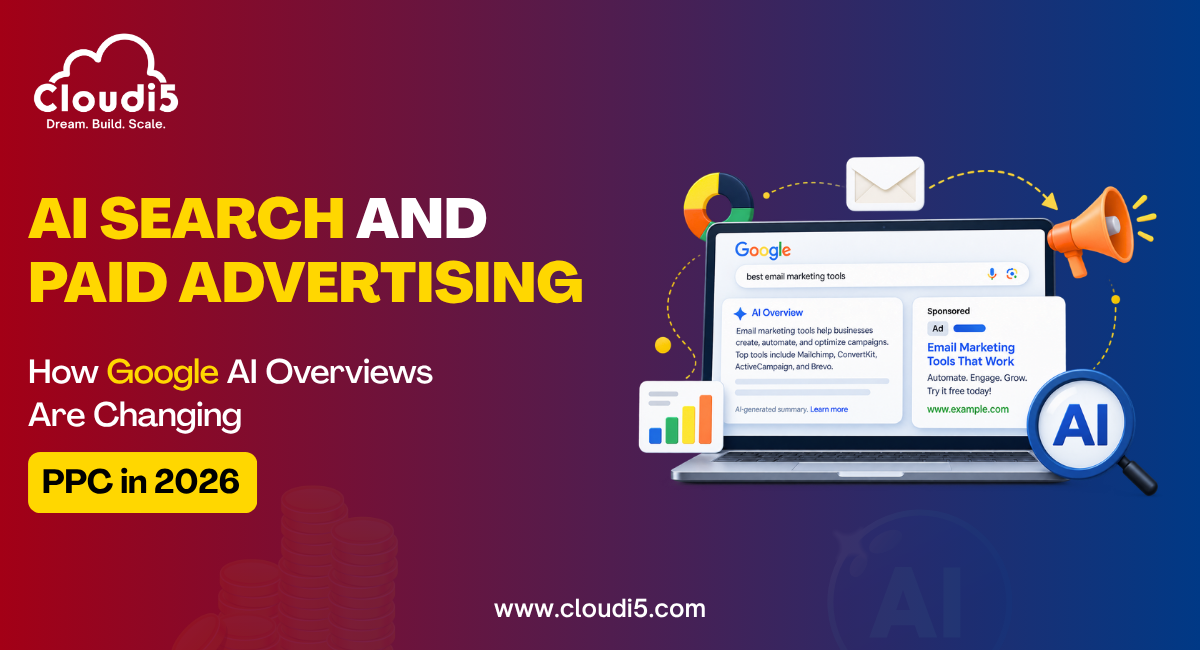
Google has expanded the placement possibilities of ads in relation to AI Overviews. Ads can show up above, below, or even inside an AI Overview depending on the search and ad campaign type. Thus, PPC is not dying due to AI search but rather evolving to fit the new reality.
In 2026, marketers should think not about specific keywords but about search intent, relevant landing pages, high-quality creatives, conversion information, and AI-based ad campaigns. To know more about how all this connects with your online business, check out the digital marketing services by Cloudi5 Technologies.
What Are Google AI Overviews, Exactly?
AI Overviews by Google are the AI-generated summaries that are displayed at the top of the results page, summarizing information from different pages into one conversational answer. Rather than reading ten different links, users receive a direct answer accompanied by a link to several sources.
In addition to AI Overviews, Google has launched a new version of AI Mode. This is a full conversational mode of search when a user can continue asking follow-up questions just like in a regular chat. Both features combined make the biggest update on the results page after featured snippets. It's part of a bigger shift toward Answer Engine Optimization (AEO) — basically, making sure your content is written in a way AI can actually pick up and quote, not just rank. Because these days, showing up in the results isn't only enough.
This changes the traditional idea of a search results page. A user might now see:
AI-generated answer → supporting sources → advertisements → organic results
The exact layout varies according to the query and Google's systems, but the underlying principle is clear: paid advertising is becoming part of a more AI-driven search journey.
How Google AI Overviews Affect PPC ?
This is the question most advertisers actually want answered: how do Google AI Overviews affect PPC performance?
The users are less likely to skip over the answer provided by AI, and hence, the organic listings and paid ads below get less attention. That produces three direct consequences for PPC campaigns:
-
Lower click-through rates on informational and broad-intent keywords, since the question is answered in the AI Overview.
-
Changed Quality Scores because lower click-through rates in the long term may change the way Google measures ad relevance and cost.
-
Unusual data in the report since Google does not provide a clear line separating "losses in clicks due to AI Overview" from other changes in traffic. A decrease in CTR may mean different things: either AI pushed your ad below or some other reasons were behind it.
None of this means PPC is becoming less effective. What it really means is that the accounts using broad keyword lists, generic ad copy, and one landing page per campaign are losing the battle. Accounts that target their audiences better and create great content perform much better under the new conditions.
1. Search journeys are becoming more conversational
Users feel more comfortable typing longer, more detailed queries.
Rather than: "PPC agency Coimbatore"
users may type:
"What should a small business consider when selecting a PPC agency in Coimbatore?"
Advertisers therefore need to think about what the intent behind the query is, not just the keyword used in the search query.
2. Ad visibility may depend on context
Google notes that when ads show up in the context of AI Overviews, both the user query and the AI Overview contents are taken into account in deciding on the ads to display.
This makes relevance increasingly important.
Your ad, landing page quality, offer, and overall website content should communicate a consistent message. A well-structured, SEO-ready website plays a vital role — you can read more on this in our blog on AI-Generated Websites: Pros, Cons & SEO Impact.
3. The traditional "keyword → ad → landing page" model is evolving
AI-driven advertising systems have many more signals at their disposal in understanding the intent behind queries and matching users with ads.
Advertisers therefore need to provide more accurate inputs to Google:
-
Accurate conversion tracking
-
Relevant landing pages
-
Strong ad assets
-
Useful website content
-
Clear business goals
-
Appropriate audience and location signals
Google AI Overviews Ads: What's Changed in 2026
Here comes the shocking truth: Google not only allows AI Overviews to run alongside your ads but actually integrates ads into AI Overviews.
In 2026, sponsored listings will start appearing as part of AI Mode and AI Overview content in the form of:
-
Inline citations within the AI-generated answer
-
Sidebar product or service recommendations
-
Suggested next steps after the AI response
Advertisers will find ads in an increasing percentage of AI Mode listings, which is on a steady rise as Google rolls out its integration plans. Notably, the proportion of ads in the high-cost-per-click terms is higher, suggesting that the competitive high-intent categories benefit the most from this new development
Google has also started tightening who's eligible to show up in these placements. Advertisers with weak account quality or inconsistent conversion tracking are seeing limited ad serving, meaning visibility isn't just about bidding higher — it's about meeting a quality bar.
Ads for Google AI Overviews: Key Considerations for Advertisers
One of the biggest misconceptions is that advertisers need to build a separate campaign specifically for AI Overviews.
This may not be the case.
At the moment, eligible ads for existing Google Search, Shopping, Performance Max, and App campaigns can run in and around AI Overviews.
Therefore, the point here is not only about How to design ads for Google AI Overviews?"
Rather, the right way would be:
How to build campaigns that will stay relevant as Google Search becomes more AI-focused?"
For More detailed insights, read our blog about how AI is changing digital marketing in 2026
Performance Max vs Traditional Search Ads in the AI Search Era
One of the biggest strategic questions for 2026 is where to put your budget: traditional Search campaigns, or Performance Max AI Mode placements.
|
Factor |
Traditional Search Ads |
Performance Max / AI Max for Search |
|
AI Overview & AI Mode eligibility |
Not automatically included |
Automatically eligible |
|
Control over keywords |
Full manual control |
Signal-based, less granular |
|
Setup effort |
Higher (manual ad groups, keywords) |
Lower, but needs strong assets and feeds |
|
Best suited for |
Niche, highly specific campaigns |
Broad visibility across Search, Shopping, YouTube, Display |
|
Data requirement |
Works with lower volume |
Needs steady conversion volume to optimize well |
there is no way to purchase a separate ad placement within the AI Overview yet. Your access to these placements happens via Performance Max and AI Max Search campaigns, and your ads being shown will depend on the quality of your product feed, ads, and audience signals rather than any additional configuration.
Creating a Strategy for Paid Search in 2026
The strategy for 2026 paid search should focus on business results instead of click volumes.
1. Start with proper conversion tracking
Before implementing automation, make sure Google Ads knows what a valuable conversion looks like.
Track meaningful actions, such as:
-
Form submissions
-
Phone calls
-
Purchases
-
Qualified leads
-
Appointment requests
-
Revenue
Otherwise, automation can go in the wrong direction.
2. Create highly relevant landing pages
Make sure your landing page reflects the user's intent. In case of advertising digital marketing services, your landing page should include:
-
Digital marketing services offered (SEO, PPC, social media, content marketing, email marketing, etc.)
-
Service packages or engagement models
-
Target industries you specialize in
-
Process/methodology you follow
-
Reporting and performance tracking
-
Contact options
The home page might not be the best choice for all cases — a dedicated landing page matched to the specific service or campaign performs better than sending traffic to a generic homepage.
3. Improve your ad assets
AI can assist with creating and adapting ad assets, but advertisers still need to provide strong source material. Also See our blog on the best AI tools every digital marketer should use.
Create clear headlines and descriptions that would convey:
-
What you offer
-
Who you help
-
Why customers should consider you
-
What action they should take
Common Mistakes to Avoid
-
Ignoring feed quality: Many advertisers assume product feed accuracy only matters for Shopping campaigns. In reality, feed data now plays a direct role in AI Overview eligibility as well.
-
Misdiagnosing Quality Score drops: A falling Quality Score is often blamed on keyword relevance, when the actual cause may be an AI Overview pushing your ad further down the page and reducing visibility.
-
Launching Performance Max without audience signals: Skipping Customer Match lists or custom segments leaves Google's AI with little to work from, which weakens optimization from the start.
-
Relying on one generic landing page for every campaign: A single page rarely matches the specific, conversational phrasing users bring into AI Mode searches, which drops conversion rates.
Why Businesses Need the Right Paid Search Partner Now ?
PPC in 2026 isn't something you can set up once and revisit every few months. Feed accuracy, audience signals, and ad creative all need consistent attention to keep pace with how quickly AI Overviews and AI Mode are reshaping search. That kind of ongoing, hands-on management is exactly where an experienced digital marketing company in Coimbatore makes a real difference — handling the day-to-day tasks.
If your Google Ads account is still running on last year's keyword lists and a single landing page for every campaign, it's worth taking a closer look now. The businesses adapting early are the ones staying visible.
Conclusion
The emergence of Google AI Overviews doesn't imply that PPC is losing relevance, but paid search is becoming an essential element of a wider AI-enhanced search experience.
The most important thing for advertisers is to determine user intent, generate high-quality conversion data, create proper landing pages, enhance ad creatives, and use automation in a strategic way. The example of AI Max for Search clearly shows that Google is heading towards more targeted and automated processes.
If you are interested in creating Google AI Overviews PPC strategy including paid search, SEO, analytics and conversion digital marketing, please get in touch with Cloudi5 Technologies. Organizations which adapt early will have an opportunity to react to the change in the behavior of people who perform searches. Instead of paying attention to the placement of ads only, marketers need to pay attention to the fact if their message gets to the potential customer.
Frequently asked questions:
1. AI Overviews set to replace paid search ads?
No. Ads are appearing within AI Overviews, not disappearing from the page entirely.
2. What is a Google AI Overview?
AI-generated overview of a search query at the top of the SERP, combining information from several sources with citations.
3. Do Cloudi5 offer any services concerning Google Ads and PPC advertising?
Yes, Cloudi5's digital marketing solutions include PPC advertising with Google Ads adjusted for search.
4. In what way do AI Overviews affect my PPC metrics?
They shift ads to a further position in the list of search results. Less visibility leads to reduced click-through rates, which may negatively impact Quality Score.
5. Can I purchase placement in an AI Overview?
No. You access an AI Overview through Performance Max and AI Max based on feed and asset quality.
6. Is Performance Max better than regular search ads these days?
Well, Performance Max leads to AI Mode, while Search allows you to be in control. Many people use both.
7. Is Cloudi5 only for businesses in Coimbatore?
No — Cloudi5 is based in Coimbatore but manages Google Ads and digital marketing for clients across regions.
8. How do I find out if my campaign got stuck due to AI Overviews?
It shows low CTR from informational keywords or some unusual ratios of impressions to clicks. An audit will clarify this quickly.
9. Can Cloudi5 also manage my SEO alongside PPC?
Yes — Cloudi5 runs SEO and PPC together, so paid and organic search work off the same keyword and content strategy instead of pulling in different directions.
10. Where do I begin to make my PPC AI-proof?
With an audit – of the feed, of audience signals, and of campaign structure. Cloudi5 can help you with free consultation.