



Use AI to summarise this article
Table of Contents:
- What to Look for in an eCommerce Platform as a Startup in 2026
- Top 5 eCommerce Platforms for Startups in 2026 (Compared)
- Quick Comparison Table
- FAQs
- Conclusion
1. What to Look for in an eCommerce Platform as a Startup in 2026?
Launching an online store in 2026 is genuinely exciting, but picking the wrong platform early on can cost you time, money, and momentum. Before diving into the list, here are the non-negotiable factors every startup must evaluate:
- Ease of Setup - You should be able to launch your store without needing a full development team. A clean, intuitive dashboard saves weeks of back-and-forth.
- Scalability -Today, you may sell 10 products. Tomorrow, 10,000. A strong, scalable ecommerce platform in 2026 should grow alongside your business without forcing you to migrate later.
- Payment Flexibility - The platform must support multiple payment gateways, including local options relevant to your market.
- Built-in SEO Tools - Organic traffic is free traffic. Platforms with solid SEO features give your store a head start in Google rankings.
- Mobile-First Experience - More than 70% of online purchases now happen on mobile devices. Your storefront has to work flawlessly on every screen size.
- App & Plugin Ecosystem - The more integrations available, the easier it is to add features like email marketing, live chat, or inventory management without custom coding.
- Customer Support - Reliable and responsive support is critical, especially during the early days when technical issues feel catastrophic.
Choosing the right platform is just the beginning. Discover the top e-commerce tools every online business should use to scale its business effectively.
At Cloudi5 Technologies, we guide startups through this exact decision-making process, matching them with the right platform based on their goals, budget, and industry.
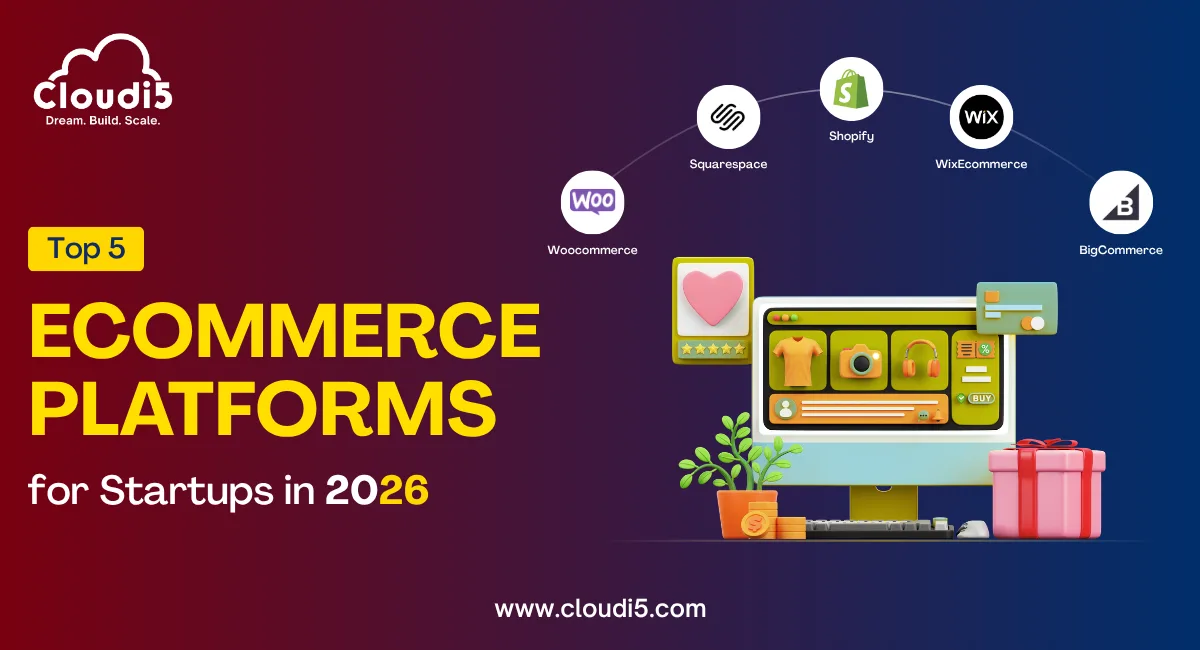
2. Top 5 eCommerce Platforms for Startups in 2026:
Here is a detailed breakdown of the best ecommerce platforms for startups in 2026, so you can stop second-guessing and start building.
1 Shopify – Best Overall eCommerce Platform for Startups
Shopify has consistently held the top spot in e-commerce for years, and in 2026, that position is stronger than ever. It is a fully hosted, all-in-one solution that takes the technical burden off your plate completely.
Why Startups Choose Shopify:
- Store setup takes hours, not weeks, no technical skills required
- Access to 100+ professional themes (free and premium options)
- Shopify Payments is built in; there's no need to configure a third-party gateway
- App store with 8,000+ integrations covering marketing, logistics, and analytics
- Multi-channel selling across Instagram, TikTok, Amazon, and more
- Automatic inventory tracking across all sales channels
- Strong abandoned cart recovery tools are built into the dashboard
- Excellent 24/7 customer support via chat, email, and phone
Best For: Startups that want a reliable, polished, ready-to-sell store with minimal technical effort and maximum support.
Worth Noting: Transaction fees apply when using external payment providers outside of Shopify Payments.
2. WooCommerce – Best Free eCommerce Platform for Beginners:
WooCommerce is the world's most popular e-commerce plugin, and it remains the number one choice as a free e-commerce platform for beginners in 2026. It runs on WordPress, giving you complete ownership of your store and data.
Why Startups Choose WooCommerce:
- Completely open-source and free to install
- Works seamlessly with WordPress, ideal if you already have a site
- Thousands of free and paid extensions for every feature you can imagine
- Full control over design, functionality, and hosting
- No monthly platform fees; only pay for your hosting and plugins
- Massive developer community with extensive documentation
- Great for content-heavy brands that want to combine blogging with selling
Best For: Startups on a tight budget or those who want full ownership and flexibility over every part of their store.
Worth Noting: WooCommerce requires more hands-on management compared to fully hosted platforms. You handle updates, security, and hosting yourself.
3. BigCommerce – Best Scalable eCommerce Platform for Fast-Growing Startups:
If growth is your primary goal, BigCommerce was built with exactly that in mind. It is one of the most powerful, scalable e-commerce platforms in 2026, offering enterprise-level features without the enterprise-level complexity.
Why Startups Choose BigCommerce:
- Zero transaction fees across all plans; every sale stays yours
- Handles large product catalogs without slowing down
- Native multi-channel selling: list on Amazon, eBay, Google Shopping, and social platforms from one dashboard
- Advanced SEO tools, including fully customizable URLs, meta tags, and schema markup
- Strong B2B features for startups targeting business clients
- Headless commerce support for brands that want a fully custom frontend
- Detailed analytics to track performance and customer behaviour
Best For: Startups with aggressive growth targets, high-volume selling plans, or those eyeing multi-channel expansion from the start.
Worth Noting: The interface has a steeper learning curve compared to Shopify or Wix, which may take some getting used to.
4 Wix eCommerce – Best Drag-and-Drop Store Builder in 2026:
Wix transformed from a simple website builder into a serious e-commerce contender, and in 2026, it is one of the easiest ways to launch a beautiful online store without writing a single line of code.
Why Startups Choose Wix eCommerce:
- Drag-and-drop editor makes designing your store genuinely enjoyable
- 500+ designer-made templates across dozens of industries
- Wix ADI (Artificial Design Intelligence) can auto-generate a personalized store layout
- Accepts payments in 50+ currencies, great for startups targeting international buyers
- Built-in email marketing, social media tools, and SEO assistant
- Quick product setup, add items, variants, and images in minutes
- Wix App Market for adding features as your business grows
Best For: Startups in fashion, food, lifestyle, or creative industries that want a visually stunning store launched quickly and affordably.
Worth Noting: Wix works best for small- to mid-sized catalogues. Very large stores with complex needs may eventually outgrow their capabilities.
5. Squarespace – Best eCommerce Platform for Design-Focused Brands
Squarespace has long been the designer's favourite, and for good reason. If your brand identity hinges on how things look, no platform matches Squarespace's visual quality in 2026.
Why Startups Choose Squarespace:
- Award-winning templates that look polished straight out of the box
- All-in-one platform, your website, portfolio, blog, and store live in one place
- Integrated email marketing campaigns with beautiful layouts
- Clean, SEO-friendly URL structures and built-in metadata management
- Strong analytics showing traffic sources, conversions, and customer journeys
- Video hosting and blogging features built in, great for content-driven brands
- Simple product management for physical and digital goods
Best For: Photographers, designers, boutique brands, and creatives who need a professional, high-end online presence quickly.
Worth Noting: Squarespace has fewer third-party app integrations compared to Shopify or WooCommerce, which can limit advanced customization.
3. Quick Comparison Table:
3. Quick Comparison Table:
| Platform | Best For | Free to Use | Transaction Fees |
| Shopify | All-round startups | No | Yes |
| WooCommerce | Budget-first beginners | Yes | No |
| BigCommerce | Fast-scaling stores | No | No |
| Wix | Creative & visual brands | No | No |
| Squarespace | Design-driven brands | No | No |
4. FAQs:
Q1. Which is the best e-commerce platform for startups in 2026?
Shopify is the most popular and beginner-friendly choice for most startups. If budget is your priority, WooCommerce is a strong free alternative that gives you full control.
Q2. Is there any free e-commerce platform for beginners?
Yes, WooCommerce is the best free e-commerce platform for beginners. You only need to pay for your hosting; the platform itself costs nothing to install and use.
Q3. Which e-commerce platform works best for small businesses in 2026?
For an e-commerce platform for small businesses in 2026, Shopify and Wix are the top picks. Both are easy to set up, mobile-optimized, and come with built-in marketing tools.
Q4. How do I pick a scalable e-commerce platform in 2026?
Focus on platforms like BigCommerce or Shopify that support multi-channel selling, large product catalogs, and advanced analytics, features you will need as your store grows.
Q5. Do I really need to hire someone to build my e-commerce store? While some platforms are DIY-friendly, working with professionals ensures your store is fast, optimized for SEO, and built to convert. It saves you time and avoids costly mistakes early on.
Conclusion:
The right platform depends on your products, your team's technical comfort, your growth ambitions, and your brand's personality.
Here is a simple decision guide:
Choose Shopify - if you want the most reliable all-in-one solution and a smooth launch experience from day one.
- Choose WooCommerce - if you are budget-conscious and comfortable managing a WordPress environment.
- Choose BigCommerce – if you have aggressive growth plans and want a truly scalable ecommerce platform in 2026 that will not hold you back.
- Choose Wix - if design speed and creative freedom matter most and your catalogue is manageable in size.
- Choose Squarespace - if you run a visually-led brand and want your store to make a strong first impression.
Still unsure? That is completely normal. Choosing between platforms feels overwhelming when you are also juggling everything else that comes with starting a business.
Cloudi5 Technologies has helped startups across various industries navigate this exact decision and then build stores that do not just look good but actually convert, as one of the most trusted names operating as an e-commerce website development company in Coimbatore.