



Use AI to summarise this article
Table of Contents
- What Is Niche Marketing?
- What Is Mass Marketing?
- Key Differences: Niche vs Mass Marketing at a Glance
- Advantages and Disadvantages of Niche Marketing
- Advantages and Disadvantages of Mass Marketing
- Real-World Examples: Brands That Won With Each Strategy
- Which Strategy Wins Long-Term?
- How to Choose the Right Strategy for Your Business
Introduction
Every business faces a big question early on: Do you try to reach everyone, or do you focus on a specific group of people who truly need what you offer?
The debate between niche marketing and mass marketing has no one-size-fits-all answer. But understanding both models can help you make smarter decisions, spend your budget wisely, and build a brand that lasts. At Cloudi5 Technologies, we've seen firsthand how the right marketing approach can transform a business's growth trajectory. Let's break it down, especially in the context of digital marketing in Coimbatore.
1. What Is Niche Marketing?
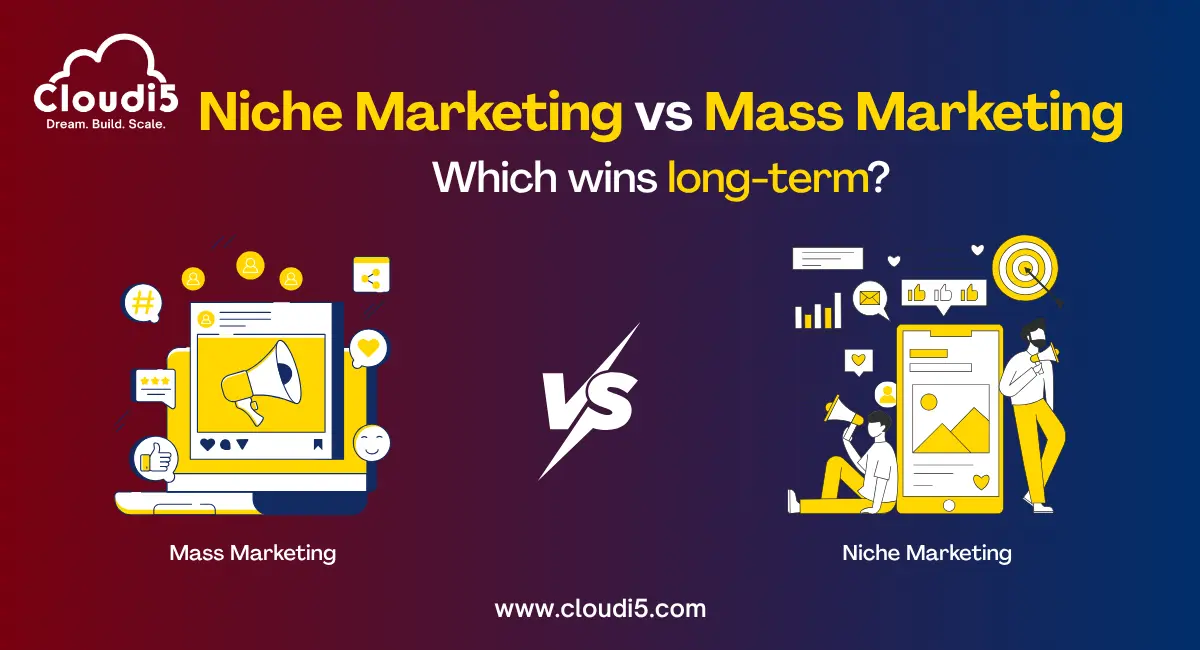
Niche marketing means focusing your efforts on a small, well-defined segment of the market, people with very specific needs, interests, or problems.
Instead of talking to everyone, you talk deeply to someone.
- You target a specific audience based on demographics, behavior, interests, or pain points
- Your messaging feels highly personal and relevant
- Your product or service solves a very specific problem better than anyone else's.
- You build strong brand loyalty within that community
Example: A skincare brand that exclusively serves people with sensitive, eczema-prone skin, rather than selling to all skin types.
At Cloudi5 Technologies, we often recommend niche marketing to startups and small businesses because it delivers better ROI on a limited budget.
2. What Is Mass Marketing?
Mass marketing is the opposite approach, you create one broad message and push it to the largest possible audience with minimal segmentation.
- You rely on high-volume channels like TV, radio, outdoor ads, and national campaigns
- The goal is maximum reach and brand awareness
- The message is generic enough to appeal to a wide range of people
- It works best for everyday products with universal appeal
Example: A soft drink brand running a national TV campaign targeting "everyone who gets thirsty."
Mass marketing has powered some of the world's biggest brands, but it comes with high costs and challenges.
3. Key Differences: Niche vs. Mass Marketing at a Glance:
Factor | Niche Marketing | Mass Marketing |
| Target audience | Narrow and specific | Broad and general |
| Message | Highly personalised | Generic and wide-reaching |
| Budget required | Lower | Higher |
| Competition | Low | Very high |
| Brand loyalty | Very strong | Moderate |
| Best suited for | SMBs, startups, specialists | Large corporations, FMCG brands |
| ROI | Higher per customer | Spread thin |
When comparing targeted and broad marketing, niche marketing consistently delivers stronger loyalty and conversion rates, especially for businesses that do not compete on a global scale.
4. Advantages and Disadvantages of Niche Marketing
Niche marketing benefits for small businesses:
- Lower competition, fewer businesses fighting for the same audience
- Higher customer loyalty-people trust brands that "get" their specific problem
- Better conversion rates-targeted messaging converts far better than generic ads
- Cost-efficient-you spend less to reach the right people
- Thought leadership-you become the go-to expert in your space
- Word-of-mouth growth, tight-knit communities spread the word faster
Disadvantages:
- Limited audience size-growth ceiling can be lower
- Market changes-if your niche shrinks, your business feels it fast
- Harder to scale-expanding beyond the niche requires a strategy shift
For Cloudi5 Technologies, niche marketing has proven especially powerful for B2B tech clients looking to dominate specific industries without blowing their entire ad budget.
5. Advantages and Disadvantages of Mass Marketing
Mass marketing advantages:
- Maximum reach-your brand gets in front of millions
- Brand recognition at scale, repeated exposure builds familiarity
- Economies of scale: production and distribution costs drop with volume
- Works for universal products-if anyone could use it, everyone should see it
Mass marketing disadvantages:
- Very expensive- TV, radio, and national campaigns are not cheap
- Low personalisation- one message can't deeply resonate with everyone
- High competition- you're fighting for attention in a saturated space
- Wasteful spend- a large portion of your audience will never buy
- Harder to measure ROI- tracking impact across broad channels is difficult.
Understanding both mass marketing advantages and mass marketing disadvantages is key before deciding where to invest.
6. Real-World Examples: Brands That Won With Each Strategy
Niche marketing wins:
- Patagonia- built a cult following by speaking exclusively to environmentally conscious outdoor enthusiasts
- Gymshark- targeted gym-focused young adults through fitness influencers before going global
- Duolingo- laser-focused on casual language learners, not professional linguists
Mass marketing wins:
- Coca-Cola- universal product, universal message: happiness for everyone
- McDonald's- broad, consistent messaging across every demographic worldwide
- Samsung- blanket global campaigns for mainstream consumer electronics
The pattern is clear- niche brands win on loyalty, mass brands win on reach. The long-term winner depends entirely on what you're building.
7. Which Strategy Wins Long-Term?
When you look at the data and trends, niche marketing tends to compound more sustainably over time, especially in the digital age, where algorithms reward highly relevant, targeted content.
Here's why niche and mass marketing outcomes differ long-term:
- Niche brands retain customers longer, reducing churn and increasing lifetime value
- Personalised marketing consistently outperforms generic campaigns on digital platforms
- Small, loyal communities drive organic growth through referrals and reviews
- Mass marketing ROI is declining as consumers tune out broad advertising
That said, the ideal path for many businesses is to start niche, then scale. Win a specific audience deeply, then expand, exactly the approach the team at Cloudi5 Technologies recommends for growing digital brands.
AI is making niche marketing more powerful than ever, smart tools now allow even small businesses to personalise at scale, giving targeted strategies a long-term edge. See how in our breakdown of Top AI Marketing Tools to Watch.
8. How to Choose the Right Strategy for Your Business
Ask yourself these questions:
- What's my budget?- Limited budget? Go niche.
- How big is my target audience?- Very specific audience? Niche wins.
- Am I selling a universal product?- Yes? Mass marketing may work.
- Do I want loyalty or volume?- Loyalty = niche; Volume = mass.
- Am I a startup or an enterprise?- Startup? Niche is your best early bet.
- What are my competitors doing?- If they're going broad, go deep.
The right mix of niche and mass marketing depends on your business stage, budget, and goals. Getting this decision right early saves enormous time and money.
If you're a local or regional business, niche marketing pairs exceptionally well with local digital strategies. Explore our guide on "Digital Marketing Practices To Grow The Local Reach Of Your Business" to build a hyper-targeted approach that drives real foot traffic and community trust, especially when leveraging digital marketing in Coimbatore.
Frequently Asked Questions (FAQs)
Q1. What is the main difference between niche marketing and mass marketing?
Niche marketing targets a specific audience with personalised messaging, while mass marketing pushes a broad message to the widest possible audience.
Q2. Is niche marketing better for small businesses?
Yes. Niche marketing benefits for small businesses include lower costs, less competition, higher conversion rates, and stronger customer loyalty, all critical advantages on a limited budget.
Q3. What are the biggest mass marketing disadvantages?
High cost, low personalisation, wasteful ad spend, and difficulty measuring ROI are the most common mass marketing disadvantages that hold brands back.
Q4. Can a business use both niche and mass marketing together?
Absolutely. Many successful brands start in a niche to build loyal communities, then layer in mass marketing as they scale. It's a proven growth framework.
Q5. How do I know which marketing strategy is right for my business?
Evaluate your budget, audience size, product type, and growth stage. If in doubt, consult a digital marketing expert like the team at Cloudi5 Technologies to build a strategy tailored to your goals.
Conclusion:
Both niche and mass marketing have their place, but long-term, niche marketing consistently builds deeper loyalty, better ROI, and stronger brand authority, especially for growing businesses. The smartest move? Start focused, win your audience, then scale. There's no perfect formula, but there is a right fit for your business. At Cloudi5 Technologies, we help brands identify and execute the strategy that drives real, sustainable growth.